CE INSTITUTE LLC BLOG

What to do If a Client Needs to Use the Bathroom During a Massage or Bodywork Appointment

What to do If a Client Needs to Use the Bathroom During a Massage or Bodywork Appointment

By Selena Belisle, CE Institute LLC Founder & Instructor

I recently had to go to the bathroom during a massage on a cruise ship!  People enjoying cruises are often eating and drinking more than they should on cruises, and I was no exception!

First is, to prevent this situation, clients should be asked if they need to use the restroom upon arrival at the massage establishment, especially if they are early. This is to help prevent their need to use a restroom during the actual massage or bodywork appointment. 

Unfortunately, if the client needs to use the restroom during an appointment, regardless of reason, practitioners must allow them to use it immediately, as soon as it is requested.  Denying the use of bathroom facilities at any time during a massage or bodywork appointment is simply bad business practices, if not inhumane or possibly even illegal to hold someone anywhere against their will.

It is good business practice to have a clean robe and slippers available for the client to use to get to the bathroom during an appointment, if the bathroom is not immediately accessible with privacy in their treatment room.  

Having a clean robe and slippers readily available in the treatment room will save time, given it’s usually quicker to slip on a robe instead of having to dress again in the client’s street clothes. Time is important because bodywork and massage appointments are usually provided for a specific period of time, and the time to use the bathroom should be INCLUDED as part of the client’s appointment time.  If they didn’t want that bathroom time included during their appointment, then they needed to show earlier for their appointment to use the restroom facilities before the appointment time started. Clients must recognize the fact that the therapist is working on a timed schedule.  That means that the therapist or other clients should not fall behind schedule because of one person’s need to use the restroom during their timed appointment, nor should a therapist's compensated time be affected by client’s bathroom break mid-appointment. This is why it’s important to ask a client if they need to use the restroom before they get on the treatment table, hopefully before the appointment time starts. Then, having a robe and slippers readily available in the treatment is recommended if a bathroom is not immediately accessible inside the treatment room, so that the effect or loss of paid treatment time is as minimal as possible to the client.  

It’s also important to make sure the bathroom is properly stocked at all times. There are some massage therapists in larger establishments that might say this is not their responsibility, but I beg to differ.  As a former Ritz Carlton Spa employee, the Ritz emphasized that all clients' needs are ALL staffs’ responsibility. The Ritz Carlton’s business philosophy was attempting to pass a patron's needs onto other staff when you could easily provide their request yourself is simple bad business.  Addressing a client’s needs with priority is the best service. As such, once a therapist dismisses themselves from the treatment room so that a naked client can dismount the table to use the restroom, it would be important to check the bathroom they will use quickly if you haven’t already, to ensure there is toilet paper, hand cleanser and a means to dry their hands after using the rest room.  

A robe will also help protect the client’s clothing if a greasy medium is on their skin, when they need the session to stop to go to the bathroom. Appropriate slippers will also help the client’s safety and stability, if they alternatively tried to use the restroom with bare feet or without socks, if greasy residue remains on their soles of their feet. Make sure that the slippers provided have good traction on harder floors, so that they do not slip, especially if they are rushing to use the bathroom! Providing items like paper slippers on harder floors can be extremely slippery, and create unnecessary risk for a client to fall while they might be drowsy or relaxed from their massage session too.  Afterall, being relaxed might have triggered their immediate need to use the rest room too.

Massage therapists who have lowered the lighting or changed the height on an electric treatment table should also readjust these items so that the client can safely dismount the table to use the rest room. Sometimes LMTs panic a little when a client says they need to use the restroom during a treatment, and they will quickly exit the room to try to save the most amount of time for the client’s hands-on service; however, this is not good or safe practice.  While we want to make a bathroom break as quick as possible for the client during a massage, especially seeing that bathroom break will count as part of their treatment time, it’s important to make sure they’re doing this safely, so that their needs are accommodated with best practices.  A client should not be exposed to injurious practices by a therapist who tried to help save a client’s time, but ended up exposing them to a higher risk of injury while doing so.

To learn more professional massage therapy practices and ideas, please visit: https://ceinstitute.com/

Simple Touches to Provide a Superior Swedish Massage Service Appointment

By Selena Belisle, CE Institute LLC Founder & Instructor

I recently experienced a Swedish massage on a cruise ship from a therapist who was training in Bali. It was wonderful. She provided some nice touches that elevated the massage experience, which I will share here.  

As a caveat before we begin, massage execution superiority is highly subjective.  Aside from issues like sanitation and safety, massage is often like ice cream, where each person might have a different favorite flavor.  One flavor of ice cream wouldn’t be considered better or more superior than another. A favorite ice cream flavor is simply a personal opinion, similar to how massage therapy is thought of, or evaluated:

Adding Sound to a Massage Appointment

The table service started and finished with a single chime of bell ringing. As demonstrated in the video below. The bell sound is pleasant, only rung once and is not overwhelming. Providing a consistent ritual in how massage appointments are started and finished is a great way to provide consistency to clients, for a more reliable experience.  Bells similar to this can be found with online retailers using search terms such as: Tibetan Tingsha Cymbals Bells. To view or hear a demonstration of a cymbals bell chime on our Youtube channel, please click HERE

Hot Towel Service with Massage and Healthcare Practices

Adding hot towels can be part of almost any massage or bodywork appointment.  It can be included as part of the service, or offered as an “add-on” for additional charge.  If charging extra for hot towel service, we recommend using aromatherapy essential oils to the water when making hot towels for various therapeutic effects, such as relaxation, energize, etc.  Just be sure to seek proper training in professional aromatherapy practices prior to application, so that you can efficiently check or respond to allergies, etc. 

Hot towel service is standardly applied to common areas such as:

  • Feet before and/or after massage. Before the service creates a more sanitary experience for the practitioner. After the massage creates better safety for the client, so the client will have better stability with their feet, when they’re not greasy while bare foot or wearing things like sandals or flip flops.

  • Hands before and/or after massage. Before the service creates a more sanitary experience for the practitioner. After creates better safety, so a client doesn’t grab a surface with a greasy hand for balance if they lose their balance and start to fall.

  • Back before and/or after massage. Before the service can create a calming effect. The moist thermal therapy can also help soften the tissues in preparation for greater bodywork.  After the massage, it can help protect a client’s clothing from greasy residue, especially if shower facilities post-massage are not available.

When applying hot towel service to the back, it’s important to start the hot towel on the upper back which is less sensitive than the lower back, as shown in our youtube video HERE.  Applying a hot towel to the lower back first can be shocking for a client, especially if the towel is extra hot.  I personally like holding the ends of a hot towel with my fingers and then enveloping the hot towel between my inner forearms to evaluate the temperature before application.  

When finishing a back massage with a hot towel, it is recommended to pull the towel up from the lower back first.  This allows a therapist to pull the drape up with the towel, so that the back is not excessively exposed to open air which can create a chilling or constrictive event for the client.

Other areas or a full body hot towel experience: providing hot towel service anywhere throughout the body  provides a more sanitary experience and helps soften the soft tissues in the applied areas. Adding essential oils for aromatic benefit can also enhance this experience.

The Use of Knuckles

While most of us use our first knuckles for deeper tissue massage applications, this therapist from Bali used her 2nd knuckles to effleurage large fleshy areas such as the erector spinae of the back. This felt wonderful and was a good switch-up from standard effleuraging with a flat or molded hand.  She managed to allow a softer 2nd knuckle massage application in those effleurage strokes, rather than the sharp pointy use of knuckles which is typically applied as shown in the picture below:

Kneading Strokes With Less Squeeze

While normal kneading or petrissage strokes are applied as an alternating squeezing of the soft tissue while the practitioner’s hands work towards one another, this therapist moves her hands with the identical alternating movement towards one another without the squeeze. It really felt wonderful, and different. Afterall, it’s important to switch-up and not repeat the same massage strokes over and over again, which can lead to boredom for both client and practitioner.

Muscles Love to Be Moved and Bones Love to Be Traced

When is the last time you have purposely worked around the calcaneus in a Swedish massage?  Usually, massage therapists will simply effleurage straight over this bone, if it’s worked on at all! In this Swedish massage, the therapist flexed my knee while I laid in pronated position, and performed several almost circular strokes around my calcaneus with her thumb and pointer finger, in a pincer type of movement. It really felt wonderful and reinforced how much bones loved to be traced in massage therapy appointments, to me. 3D Photo of calcaneus bone below attributed to: BodyParts3D is made by DBCLS. - Polygon data is from BodyParts3D, CC BY-SA 2.1 jp, wiki28324270


Sanitation is Key

My massage journey is always improved when I’m not worried about sanitation.  This massage therapist washed her hands after entering the room, prior to starting my massage. She washed her hands again before providing my facial massage at the end of the appointment, where she incorporated some acupressure points over my sinuses to relieve them, and then washed her hands for a third time, before exiting the treatment room. The linens were clean and bleached white, void of any snags, tears or soiling. The room was extremely clean, without any dust or dirtiness. All of this allowed me to relax and enjoy the massage itself.


In Summary

There are a lot of wonderful touches that can be added to a massage session beyond anything I could extensively write about here.  I feel the best way to learn these touches is by seeking massage appointments from others, similar to how I experienced this massage appointment.  

If you want to learn additional massage practice above and beyond what was taught in school, CE classes like what we teach are a great way to obtain that information.  However, we also recommend seeking massage from others who were not trained in the same place as you.  One of the best places to seek massage from therapists trained from all over the world is on cruise ships.  Cruise ships regularly employ massage therapists from many different countries and backgrounds.  

When a therapist is in one area where most were trained by the same instructors in the same handful of local massage schools, their often trained in the same applications and strokes, sometimes with little diversity. Trying to learn new techniques from other therapists in the area may prove difficult. As such, it’s more than likely that you’ll meet a new therapist practicing different techniques when you book a massage on a cruise. You might be able to use that experience as a tax write-off benefit too!  Just check with your own licensed accountant first. Sometimes cruise massage isn’t great, and you can learn from that too. It’s equally valuable to learn what doesn’t feel good, so that you never repeat the same!

For more information about massage therapy education and practices, please visit: https://ceinstitute.com/

Manual Hydraulic Spa Treatment & Massage Therapy Table Example

By Selena Belisle, CE Institute LLC Founder & Instructor

On a recent cruise, I found fairly unique hydraulic massage tables in use and took this video to share with students.  This might be a great option for therapists who cannot afford electric treatment tables, but do not want to take 4 legs off a table to adjust the height between clients:  

To learn more about general business practices, please visit: https://ceinstitute.com

LMTs Earn Extra Income with a Facial Massage Add-on Service Appointment

LMTs Earn Extra Income with a Facial Massage Add-on Service Appointment

Providing add-on services in a spa, health or massage establishment is a great way to maximize income client experience.  On a recent cruise, I was provided a list of options available to add-on with my hot stone massage appointment, as shown below:

In the case of the 15-minute facial massage add-on, I’d like to point out that it was a more lucrative appointment for the therapist than the original service itself.  A 15 minute facial massage was 29 euro while the 50-minute hot stone massage was 74 euro. That means the therapist earned 1.93 euro per minute during the add-on service versus $1.48 euro per minute during the main massage appointment.

Add-on services are a great way to fill a provider's schedule to increase earnings while expanding on the client’s experience. In this case, the facial massage was so strong and enjoyable, that it made me consider scheduling an additional 50-minute spa facial appointment beyond what was already booked, which again further increases business income. 

Adding on enjoyable experiences can also increase the chances of positive word-of-mouth.  Business advertising can be quite expensive, so free word-of-mouth reviews and referrals are preferred.

When an establishment is fully booked, then add-ons should not need to be offered. It’s important to run on time, when selling time. Usually add-ons are provided at a discount, especially when the client is already on a table. Some of the reasons add-ons are usually less expensive is because: 

  • Saved time without the need for a second client or medical intake process with the same client, unless particular allergies, precautions and contraindications for the add-on service were not discussed during original intake.

  • There’s no need for extra linens which further saves on business laundry expenses.

  • Service time is maximized when the same client stays in the same treatment room, instead of having to change it over for another client.

There was one feature of the add-on facial massage experience that was not enjoyable, which was the massage therapist used a facial serum as their massage medium which was dripped onto the face.  The serum bottle had a dropper. Dropping drips of liquid onto the face, especially a few inches above the face where it really drips and splashes over the face did not feel enjoyable to me; however, that could be a subjective experience. Splashing fluids a client’s face could enter their eyes, hair, nostrils, or mouth which would all be considered inappropriate applications.

For greater massage and spa training, please visit:  https://ceinstitute.com/

Massage Therapist Cruise Ship Work Contract Caveat: Act of War

Massage Therapist Cruise Ship Work Contract Caveat: Act of War

Working on a cruise ship as a massage therapist has its pros and cons.  Each individual would have their own opinion whether it's the best option for themselves.  Some enjoy it and some don’t. 

During a cruise in April 2026, I had a massage with a woman who was contracted to provide massage therapy on a ship that was supposed to cruise in the Arabian Sea and around Africa.  She was from the Philippines, and this was her 8th contract with the cruise line. She signed up for an 8th contract because she wanted to tour this new area of the world.  

Some time later once she was actually on the ship, the US and Israel started bombing Iran, which made cruising around these areas unsafe.  As a result, the cruise line cancelled their sailings, and repositioned the ship without passengers to the Caribbean.

When the cruise line decided to move their ship from this new war-time vulnerable area, they cancelled their itinerary and sailed without passengers, but the staff remained. This personally makes me wonder about the company’s concern for their own staff.  If it wasn’t safe for passengers, why did they keep over 1,000 staff on-board? 

Let’s review what happened to the massage therapist who had a work contract in this predicament:

  1. Massage therapists with this particular cruise line earn a base salary with service commissions and gratuity pooling, so her earnings were much less when the ship sailed without passengers for several weeks while it waited to sail when it was safer, and then repositioned itself through an empty trans-atlantic cruise to the Caribbean.  

  2. She was unable to see the region she had originally signed up for, which is why she had sought that 8th work contract on this cruise line.  The ship was sailing back to the Caribbean where she had already worked for several other contracts, so she was deprived of going to a new region that she really wanted to travel and see.

  3. When they were able to sail out of this war zone, they did so quite quickly through rough waters which made her sea sick. Luckily free medical care provided her what she called “injections” and other medications to combat this illness, which is commonly given to staff who become sea sick while working onboard.*

  4. On the bright side, she still received her base salary which was fairly low and had the benefits of free meals, housing and medical care while the ship waited, and then repositioned itself into a safer area with staff only. 

  5. She received extra industry training and lighter work duties (such as cleaning) while guests were not on-board.

  6. She said the staff enjoyed a lot of parties after work hours that they normally would not have.

  7. She also said they got to use some of the guest areas on the ship which are off-limits restricted to staff.

So, if you’re seeking to work on a cruise line, these are some of the things that you might want to consider, beyond some of the more recent concerns that could leave a massage therapist with less income or personal opportunity. There are other obvious concerns with working on cruise lines which have become more prevalent today, such as contagious viruses (RSV, norovirus, COVID, etc.) that would make working on a cruise ship less desirable, and negatively affect income. But can you imagine signing up for your 8th contract to see a new area of the world and then miss it, plus earn less too? 

Some massage therapists work on cruise lines because they earn more on ships than what they can earn in their native country. Also, cruise ships on international waters do not need to meet various government licensing requirements which makes employment easier for the ship and staff. However, if you’re a massage therapist thinking that you can sign up with a cruise line to see the world, and contract for a particular area of the world you wish to see, just remember these harsh realities. While everyone’s work can be affected by unforeseen circumstances, it seems that massage therapists employed on cruise ships have more to consider than other employment.

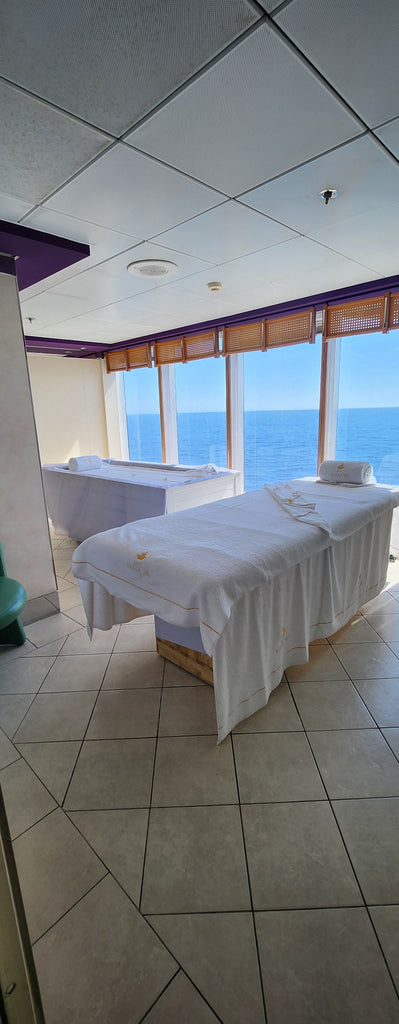
* On two of my last cruises, I met a few massage therapists who became sea sick during work. They stated they received these same “injections” and medications to combat sea sickness, and were sent back to work to provide massage appointments! They said they normally don’t get sea sick, however, those cruises encountered unusually rough waters as we sailed through Cyclone Erminio and other storms. So please be aware that sea sickness on cruise ships does not mean you will get the day off.  One of the therapists stated she had been vomiting, and was sent back to work on medication.  Tip to massage therapists working in treatment rooms with windows on cruise ships through rough water: the therapist kept the window blinds closed in the treatment room so as to not see the rough waters we were sailing through, and claimed that seeing the waves made her feel worse. So, if you’re working on a cruise ship and develop sea sickness and are still required to work, it might be best to request a treatment room that doesn’t have a window, and if it does, close the blinds such as what's pictured below!

A Professional Evaluation of Poor Foot Reflexology Appointment Examples

A Professional Evaluation of Poor Foot Reflexology Appointment Examples

By Selena Belisle, CE Institute LLC Founder & Instructor

Please note that our professional evaluations do not name practitioner's or establishments. Any identifying information is purposely not shared. This is solely a learning example for to improve practices, and should not be used to embarass or cause harm to others: 

I had two reflexology appointments recently, only days apart, with both being disappointing, if they were to be evaluated as true reflexology appointments. Neither felt similar to the traditional evidence-based reflexology practice we teach here at the school, which is slightly similar to the Ingham method.  Different does not always mean it is better or worse; however, in these two instances, I felt practically no benefit after the treatments, so in my 25+ year experience of reflexology training and estimation, both reflexology sessions were not provided well, or with best practices.

Foot Reflexology in a Typical Asian Nail Salon

The first reflexology appointment I had was in a typical Asian salon in Barcelona, Spain.  I dislike using the term Asian salon; however, the staff working on the day of my service all appeared to be of Asian descent speaking Mandarin, with Mandarin language or symbols printed on their Reflexology advertisement chart. They continually spoke Mandarin during open client services where the clients can watch and hear them endlessly chat and laugh amongst themselves. I feel chatting and laughing amongst staff in a foreign language is unprofessional when a client is paying for a relaxation or healing bodywork, such as a reflexology appointment. Their reflexology was 25 euros for a 30-minute appointment.

The reflexology appointment started with a traditional foot soak in a plastic lined bucket as pictured below. The plastic lining is supposed to be for hygiene purposes, as long as the plastic lining is new, and changed for every customer. A recommended practice to increase client confidence would be to change the plastic liner in front of the client, where a new plastic liner is installed in view of the client so that they know that the foot water bath has been especially created for them. The water was of good temperature, and the soak lasted for an appropriate length of time which was less than 5 minutes. It was a bubbly soak which was fun, although I could not smell any aromatic enhancements to improve the foot soak experience.

I was seated upright in a chair station where pedicures were also provided, in an open area where I could observe other clients and practitioners, providing and/or receiving both nail and massage services.

The reflexologist dried my feet after the soak, and offered an upgraded medicinal oil that was purported to provide greater therapeutic benefit for an additional 5 euro. This is a fantastic business tactic, because it can increase earnings without any extra labor, and could enhance the client’s experience as well. I declined the upgrade because no specifics were provided, such as what the ingredients are in the medicinal oil that provided greater benefits. 

Oftentimes, ingredients such as menthols are used for foot treatments to increase circulation.  Unfortunately, applying menthol to the feet can create a tingly and/or chilling effect which I was uninterested in because it was only 55 degrees Fahrenheit outside, and I didn’t want to be colder than what I already was. The medicinal oil add-on appeared to be concocted at the establishment in a plain glass bottle without any labels. The fact that the oil was in a glass bottle used over a hard tile floor made me think that essential oils had been added. It’s always better to use glass instead of plastic with essential oils, because essential oils regularly degrade plastic. If it had been clear that there were woody or spicy essential oils that cause a warming effect on the skin in their medicinal concoction 5 euro add-on, then I surely would have accepted the upgrade! 

NOTE to providers: If you would like to earn extra income with massage medium upgrades: make sure you have an ingredients list to show clients to not only avoid allergic reactions, but to also help sell your product, especially when language barriers are present. Barcelona’s top industry is tourism; however, I was in an Asian salon where the national language is Spanish and the staff only seemed to speak Mandarin, so communication was a major challenge beyond pointing at service pictures with prices. Even if the ingredients have been printed in a foreign language, such as the most commonly used Roman or Latin language, consumers could then use their cell phones to translate what the ingredients are to make a more educated decision with the 5 euro upgrade.  It’s important to provide informed consent with every appointment, and there is no informed consent when a client wants to know what’s being applied to their body, and the information is not properly disclosed.

The treatment on my feet felt more like regular massage, accupressure or Tuina, more so than a reflexology session.  While specific areas of one foot were worked on at a time, the strokes did not resemble reflexology practice such as stimulating a specific reflexology point.  To the contrary, the hands-on application felt more like a blend of relaxation and deep tissue techniques applied to the lower legs plus sole and dorsum of each foot. Also, when the practitioner felt tension or restriction in the soft tissues of the sole of the foot such as the plantar fascia area, she focussed on that area to stretch and soften the tight muscle and fascia. Stretching plantar fascia is considered to be more of a massage technique than a reflexology practice.

The provider themselves had one of the best touches I had ever felt in my almost 40-year career of massage and bodywork.  While she wore gloves for proper hygiene when working on my feet, the contact was full and firm with proper rhythm and pressure. There was a sureness and confidence in the touch, like they were born to do it. The establishment also provided oil body massage which I surely wanted to seek once I felt the incredible touch of this practitioner; however, once my “reflexology” was concluded, she pulled the towel out from under my legs which placed my oily legs directly on the foot stool’s upholstery, so I decided against seeking further service due to hygiene and unprofessionalism concerns, where there was endless chatter and laughter amongst the staff during client service.  

Foot Reflexology on a Cruise Ship

The second comparable foot reflexology appointment I experienced in the same week was on a cruise ship.  It was a 50-minute session for about 99 euros (plus a mandatory 15% gratuity) This session started in a private treatment room where I was asked to remove my pants only, and lie in the supinated position on a massage treatment table. A knee bolster (pictured below) should be provided when a client is lying in the supinated position on a treatment table, to help avoid low back stain and also possibly help with any pain that knee extension when lying on a flat table for a long period of time.  Unfortunately, the reflexologist did not provide a knee bolster, and given what this same establishment provided for a bolster in a previous massage session, I did not ask for one either. 

NOTE TO BODYWORKERS: Please be sure to have proper equipment when providing bodyworker services such as reflexology.  Not having proper equipment is just plain bad business, especially when professional prices are being charged such as in both of these reflexology appointment examples.

The reflexologist on the cruise ship was from Indonesia, and had practiced in Bali for three years prior to accepting repeated cruise contracts to work onboard. She also spent over one year in full-time training prior to practicing reflexology, massage and other bodywork, so she had plentiful experience. Please keep in mind that a popular average of a massage therapist career is only about seven years total, with some working much longer than this while others do not last their first year.

This reflexology session on the cruise ship had no medical intake, similar to the other appointment in Barcelona.  

NOTE TO BODYWORKERS: It’s important to always conduct a medical intake, to avoid applying a medium to the skin that the client could be allergic to, and to avoid other contraindications such as working on a client who has an infectious disease.

Sanitizing the Feet Prior to Cruise Ship Reflexology Appointment

A hot towel was used to cleanse the feet which is another acceptable hygiene practice prior to reflexology application.  Unfortunately the “hot towel” out of the cabi was barely luke warm, so it wasn’t as comfortable or enjoyable as a true hot towel service.  

NOTE TO BODYWORKERS:  Use hot water when making hot towels, before placing them in a hot towel cabi.  Towels soaked in cold water could take several hours to thoroughly heat, especially when a stack of towels is placed on top of one another.

To improve a client experience when no hot towels are readily available yet needed:

  1. When a sink is readily available next to the client: run hot water until it is hot, and then wet the towel with hot water, then immediately apply to the client while it is still comfortable to both of you.

  2. When a microwave is readily available next to the client: nuke the wet towel in the microwave for a few seconds, then immediately apply to the client while it is still comfortable to both of you.

Be careful not to burn a client with a hot towel too. Hot towel cabis, such as the one pictured below, are know to heat up to 150+ degrees Fahrenheit!

The reflexology on the cruise ship did not feel like a true reflexology session, similar to the Barcelona appointment.  A series of massage and deep tissue strokes were used with oil.  

NOTE TO BODYWORKERS: We prefer using cream or lotion during foot reflexology appointments so that both gliding and specific point stimulation techniques can be easily applied without slipping or sliding away from the reflexology point being worked on.  Oil is a poor medium choice for reflexology.  Oil does not absorb well into the thicker skin of the sole of the foot. As such, the bottoms of the feet can remain slippery which is a problem when the client is wearing sandals or flip flops.  A client can slip and fall with oily feet, which would be a liability of the practitioner and business establishment when/where the oil was applied.

The hands-on application of the reflexology on the cruise did not have the same superior touch as what I found in the previous salon in Barcelona. While it was good contact, it did not have the same fullness or confidence. The strokes were appropriately slow; however, the practitioner used her pointer finger knuckle for a lot of the application which felt like a wooden tool. Her knuckle felt extremely sharp and she pushed really hard with forceful pressure, which was quite painful on the soles of my feet and toes.  I had to repeatedly ask for less pressure so that it wasn’t uncomfortable. In the end, the pressure felt like she applied the same for all clients instead of customizing the reflexology to meet the client’s wishes or needs, which would be more appropriate for a true therapeutic result.

The reflexology was also practiced in a manner that didn’t recognize the zones of the feet as we teach here at the school pictured below, unless the reflexologist was only trying to stimulate the pulmonary and abdominal area.  Our professional reflexology practice asks reflexologists to work an entire zone, from the tip of the toes to the heel of the foot, and then quadrants of the zones are worked individually.  We do not work two quadrants in a singular stroke while leaving the remaining two quadrants, superior and inferior to the middle untreated.  This is one of several examples of why it felt more like a foot massage than a true reflexology session to me.  We feel that true reflexology has a more sensical application when working different zones and points of the feet.

Overall, both sessions felt acceptable if they were to be considered average foot massages instead of reflexology sessions, with the treatment in Barcelona far superior, due to the natural skill level of the practitioner’s incredible touch.  

NOTE TO BODYWORKERS: It is our recommendation in true reflexology practice to learn common reflexology points as pictured in the chart below, and then discuss these with a client when working each area, such as I’m stimulating your sinus, thyroid or intestinal points now, etc. We teach interactive reflexology, such as having a client take a deep breath when we work the diaphragm reflexology area. This is one way to separate working on the feet between reflexology practice and regular foot massage.  

Reflexologist’s Intentions Can Create a Better Appointment

We believe the reflexologist’s intention helps provide a better result in reflexology practice, to the point that some feel therapeutic benefits in the various body areas where reflexology points were stimulated.  I have even experienced feeling lighter and overall full body improvement from a singular reflexology session practiced solely on the feet. Unfortunately I did not feel any of these benefits with these two reflexology sessions, which was a disappointing yet educating result to share.

To learn more about reflexology practice, please visit: https://ceinstitute.com/collections/reflexology

 

The Old Dirty Business of Cruise Ship Massage Therapy Practice

The Old Dirty Business of Cruise Ship Massage Therapy Practice

Going on a cruise should mean enjoyment and relaxation. You don’t have to cook and someone cleans your room and makes your bed. What could be better? Perhaps a massage?  Well many cruise lines have that covered too, depending on your personal standards!

Massage and spa appointments are fairly typical services amongst consumers who take cruise vacations. As of 2026, there’s no specific data that shows what percentage of cruise passengers book massage or spa appointments; however, cruise ship spas are regularly full during sea days. As such, a massage appointment is fairly coveted, and consumers generally accept what they are provided, even when it’s not the best. In this article, it's important to point out that I am not singling out any particular cruise line, but instead reviewing general cruise line massage practices that are common amongst almost all cruise ship brands and spas.

Most cruise lines booked 50-minute massage appointments on the hour, every hour as standard practice for years. Unfortunately, during COVID, we experienced a significant reduction in practicing massage therapists which might have eased employment standards and gruelling schedules.

For many years, the spas in cruise companies got away with anything and everything, between charging exorbitant prices for massage appointments to costly upgrades that were not disclosed until checkout, where embarrassed passengers paid whatever was charged seeing they agreed to the upgrade while half conscious during their spa appointment. There’s been a lot of unethical and dirty massage industry business on cruise lines.

Another peculiar cruise ship practice for the massage industry is the lack of knee or ankle bolsters.  I’ve personally cruised a variety of different cruise line companies, and I believe the lack of bolsters amongst almost all cruise lines stems from a number of factors including:

  1. A bolster is significantly more expensive than a rolled up towel which is commonly used in place of a bolster.

  2. Cruise ships lack space. A bolster is slightly bulky and takes up valuable space in a treatment room.

  3. Bolster upholstery can peel and become unsightly, especially when not used properly, such as covering it with a new cover with each massage appointment. This requires replacement and greater equipment costs.

  4. Massage bolsters are not a one size fits all commodity. come in various sizes, and some clients might like a smaller or larger bolster, which makes it even more difficult to stock all different types of bolster sizes.

The dirty practice of bolstering has become, massage therapists are rolling up towels and reusing these with every client, to avoid laundry expenses.  This could be a clean practice if the massage therapist placed their rolled towel UNDER the client’s bottom sheet draping.  But unfortunately, most therapists place rolled towels directly under a client's ankles or knees, if they use any bolstering at all. The rolled towel is considered “contaminated” once it contacts a client’s skin, and should be laundered instead of reused.  This is the dirty element of using rolled towels for bolstering during massage.  These rolled towel bolsters should either be placed under other draping, or immediately laundered if it touches the client’s skin.

In my cruise ship massage appointment today which spirited me to write this article, I asked the massage therapist to provide an ankle bolster before she left the room.  She agreed to do so, and then pulled out a filthy rolled up towel and placed it top on the pristine towels which really showed how dirty it was! In the picture below, you can see the dirty towel rolled up when compared to the clean rolled up towel.

The therapist had two towels rolled up together that had been reused so many times, that the towels were now becoming grey in color.  When I told her I didn’t want these filthy reused rolled towels as my bolster, she then rolled a single clean towel for my bolster which was inadequate in height.  So while my new rolled towel bolster was smaller and flatter than the therapist’s regular one, at least it was clean and there was less chance of developing an infection from coming in contact with something that had such obvious filth.

On another note, when I told her I didn’t want the rolled up dirty towel to be used as a bolster, she put that filthy rolled up towel right back from where she took it instead of placing it in a place to be laundered.  It is my guess those filthy rolled towels will undoubtedly be used for other unknowing clients, if the client receives any bolstering at all, given I wasn’t provided anything until I asked for one.

Massage therapists have been using large rolled up towels for decades as knee and ankle bolsters; however, the expense of laundering those towels would cost more than a regular knee/ankle bolster (pictured above is a 6 inch 3/4 bloster). So how could a business with minimal space keep their expenses low while properly supplied?  The answer in the cruise industry is they reuse towels as bolsters, and that creates a real sanitation problem when the massage therapist places a towel bolster in direct contact to a client’s bare legs.

While it’s okay to use the same rolled up towel in place of an ankle or knee bolster, it must be used properly. It’s important to remember to place the rolled up towel underneath the clean table drape, so that the rolled up towel is not coming into contact with each client.  Also, if the client sweats through the table drape, or if a spa product such as a body scrub leaks through the bottom draping onto the rolled towel bolster, then it should be laundered and replaced, to avoid sanitation issues such as odor causing bacteria to form, or worse.

You Don't Always Get What You Pay For in a Cruise Ship Spa

Balinese massage is often described as a blend of bodywork techniques that could include acupressure, deep tissue massage, skin rolling, plucking or flicking, lighter massage strokes including tapotement, stretching, aromatherapy and other applications. Overall, a balinese massage is supposed to leave a client relaxed and refreshed at the end of the session. I recently scheduled a balinese massage on a cruise ship, and the therapist provide a regular Swedish massage instead, which was entirely comprised of effleurage and kneading strokes. When I asked the therapist how they thought their balinese massage was different from a regular Swedish appointment, they responded they didn’t know and they just did what their school taught them to do. Unfortunately the balinese massage was twenty euro more expensive than a Swedish, so lesson learned, sometimes you don’t always get what you pay for in a cruise ship spa.

While most of my recent cruise ship spa experiences have been positive, this article was based on a few bad experiences over several different cruise lines, where dirty or unethical practices seemed to be commonplace for their industry. Cruise massage does not have to be dirty business with proper procedures and application.  To learn more about appropriate massage therapy practices, please register for more training with us at: https://ceinstitute.com


Some NEW Facts About Basalt Lava Stones Used in Hot Stone Massage

Some NEW Facts About Basalt Lava Stones Used in Hot Stone Massage

Many Original Hot Stone Massage Practices Have Been Updated or Retired

Did you know that the number one liability in the massage industry became hot stone massage practice?  That’s because quite a few clients have burned due to improper application or lack of training or care. 

One instance of a retired hot stone massage practice is stones should no longer be placed stationary on bare skin, as shown in the picture above. Stantionary stones must be the correct temperature, and placed on top of two physical barriers when applied to a client, as taught in our hot stone massage classes, and recomended by the ABMP. 

Many of the older hot stone massage practices required extreme attention to temperature and application, and when this wasn’t used properly, clients were burned.  As such, the hot stone massage industry has eliminated some of its older practices in an attempt to prevent burn injuries during hot stone massage, which you can learn more about by taking our hot stone massage training, and by clicking HERE.

Where Did the Word Basalt Come From?

The word or term “basalt” was created by Wedgwood, an English fine china and porcelain manufacturer founded in the 1700s, as explained in the picture below from the Birmingham Museum of Art

While most Wedgwood objects are light blue and white, called “Wedgwood Blue”, a second color pattern of black and white was then created and named “Black Basalt” as pictured here in Birmingham:


When I personally think of black basalt lava stones, I feel like that term should have been born from Hawaiian language where the lava is so prevalent.  It was interesting to learn the term “basalt” came from an English fine china manufacturer instead, as explained by this museum of fine art in Birmingham.

Why are Older Naturally Tumbled Stones for Hot Stone Massage Rusted or Dented?

First is, there is a clear difference between a rusted, slightly dented and cracked or sharp stone. We never used cracked stones or stones that have rough edges. If a stone is cracked or has a rough edge, then it should not be used for massage, ever. Please properly discard a cracked or sharp edge stone immediately.

If you’re in the market and looking to purchase used stones, don’t worry if you find stones that are rusted or have small indents (pictured below). Believe it or not, those dented stones are usually more desirable (these will be small indents as pictured below and NOT CRACKS!)  

Stones from hot stone massage that have small indents are where metallic content used to sit, and was likely rusted away, leaving the indent where that metallic content used to sit.  So if the outer layer of the stone has small indents from where metallic content rusted away during use, that means the inner core of the stone likely has that same rich metallic content which can conduct and retain heat longer than other stones.  That higher metallic content are the types of stones we want to use for hot stone massage or thermal therapy. If you think about it, hot stones are regularly sitting in hot water, and that’s what causes some of the metallic content of the outer stone to rust and eventually leech out of the stone leaving those small indentations as pictured below. 

On a final note, if a hot stone somehow becomes brittle or those metal leeching indentations turn into sharp cracks or rough edges to the point that it could cut a client or the practitioner, then it should be discarded and no longer used for hot stone massage. I have personally never seen metal leeching from a basalt lava stone to cause it to become sharp, brittle or cracked; however, there might be a possibility that could happen. It is important to place human safety as paramount when compared to attempting to save the use of an inappropriate stone.

Why Are My Brand New Basalt Lava Stones Grey?

Black basalt lava stones are regularly grey (as pictured below) when shipped or found dry in nature.  They turn that beautiful deep rich black in color once the stone is wet or cured with oil.  We teach this process as well as how to “recharge” stones in our hot stone massage CE courses.

To learn more about hot stone massage therapy practices, please visit: https://ceinstitute.com/collections/hot-stone


Where Can I Get the Best Stones for Hot Stone Massage?

Where Can I Get the Best Stones for Hot Stone Massage?

By Selena Belisle, CE Institute LLC Founder & Instructor

Hot stone massage is a wonderful thermal therapy bodywork because of its heat. It’s not the stone by itself that makes a hot stone massage feel good. It’s the HEAT in the stone with a carefully trained and skillful application that creates that incredible hot stone massage experience. Afterall, massaging someone with a room temperature stone usually does not feel good at all. That’s why it’s important to use the right stones for hot stone massage. Sharing what we would consider to be the best stones requires providing some basic information, so that massage therapists can make an educated choice to find the absolute best stones.

The type of stone that should be used for hot stone massage is an opinion to some; however, most hot stone professionals agree that black basalt lava spewn from volcanic eruptions is best. That’s because some volcanic basalt lava has very high metallic content which can conduct and hold heat longer than most other stones or materials. Basalt lava can have other colors such as green and redish stones; however, in this article, we're going to focus on the most common and popular black variety.

Most random stones do not have the higher metallic content of the basalt lava. There are other reasons we chose black basalt lava from volcanic eruptions, such as it’s born from tremendous energy which is further shared in our hot stone massage training. Hot stone massage can be a wonderful energetic therapy to recharge the body and more. Below is a picture of Hawaiian Big Island's Kīlauea volcano smoldering in November 2017 before it errupted in May 2018. Can you see or feel the energy from it?
Can I Use Stones From Landscaping Stores for Hot Stone Massage?

I would say no, with the following information. I have taught hot stone massage for a few decades now, and in some recent classes, I’ve had other licensed massage therapists tell me that they simply picked up a bag of black round smooth stones at Home Depot, Lowes, and other landscaping supply stores (pictures of these are below).  The students who are also LMTs said using those landscaping stones is the same basalt lava stones as others cultivated and shipped by professional stone retailers.  So, I did a test myself and found that they are not the same, and we do NOT recommend these!

The black round stones that are sold in landscaping supply stores for the purposes of lining a driveway or making walkway paths, etc., are of a lighter material.  That means they have less metallic content, because it’s the metal within the hot stones that make them heavier.  That means, while those cheaper landscaping stones might look the same, they do not retain the heat as long as the professional basalt lava stones sold by ethical hot stone retailers. 

To prove the point, stone suppliers need to ship their product to landscaping retailers, which can be costly.  Logistically, stone suppliers will be choosing the lightest stones possible to save on shipping costs.  That means, the black round stones sold at landscaping companies would have the least metallic content within them to avoid excessive weight and shipping costs, when delivering them to landscaping retailers.

Why It's Important to Use the Right Stones for Hot Stone Massage

Please keep in mind that even some of the best hot stone sets might only retain heat for a minute or two per stone.  A regular river stone picked from the river or even a basalt stone picked up from the beach (as shown in the picture below from the Volcanic island of Madeira Portugal) might only retain heat for a few seconds. This is why it’s so important to use proper stones (aka as service products or materials), in hot stone massage. 

The longer the stone retains the heat, the longer the enjoyable thermal therapy exchange will be provided to the client. Changing stones during hot stone massage is inevitable, to keep the session going with stones that are always hot. The key is to keep your stones hot, and not have to change them so frequently by using proper stones that retain heat the longest.

Can I Pick My Own Stones Naturally To Create My Own Hot Stone Massage Kit?

This is a tricky question. The answer is yes and no, unless you get luckier than I was. You can pick your own stones and use them, however, you must have the legal right to do so.  

I have visited two archipelago groups of islands made from volcanic eruption with basalt lava stones abundantly available on the beaches of Hawaii (pictured below) and Madeira, Portugal.  In both islands, I found the same beautiful tumbled black lava stones on their beaches.  The problem is, it’s hit or miss if you can find black lava stones amongst these millions of tumbled stones that have the higher metallic content.  My experience is that tumble polished lighter stones are what wash up on the beaches. Those lighter stones that wash up on the beaches lack the heavy metallic content that is required for professional hot stone massage.

Here's a short video showing basalt lava stones naturally tumbling in the ocean waves which is what makes the stones naturally smooth after millions of years of tumbling. Just imagine the energy charged into these stones with this action:

Not All Basalt Lava is The Same

It's important to note that not all basalt lava creates great stones for hot stone massage. That's because basalt lava can have larger variables, and is not all the same.  In the pic below from a Hawaiian lava field, you can see that this particular basalt lava field is porous, which would be great for shipping a lighter stone to save on shipping expense, while it would be a poor lava candidate for hot stone massage application.  Unfortunately, after machine polishing, it would be hard to identify porous stones versus those with a large metallic content; however, professional hot stone retailers usually sell the heavier and higher metallic content stones.

This porous lava pictured above is much different than high metallic content lava that can leave tiny and more sparse pitting from the leaching of metal from the stone.

Let’s Not Break the Law to Practice Hot Stone Massage

Most states, countries or places will not let someone just take natural resources, such as removing beautiful stones from a public beach. It’s usually against the law to do so. People cannot, and should not go to a volcanic archipelago and grab some stones from public or private areas to take or keep. While that could save a therapist $80ish from having to order stones from a professional stone supplier, you might also be breaking the law, and adding a lot of bad energy to your bodywork with that logic. Of course you could pick stones from your own property, but the question is, do you have volcanic basalt lava with a heavy metallic content in your backyard?

I stayed at the Kalani Oceanside Retreat for Lomi Lomi training In Big Island, Hawaii. Every morning, guests were invited to swim at the local black sand beach that was just filled with naturally smooth and tumbled black lava stones (pics below). I asked if I would be able to take some of the stones back to the retreat to test them, and then return the stones back to the beach the next day, and they said yes, so I did.  This is how I found that picking what appeared to be some of the most beautiful thick black basalt lava stones from the black sand beach would not guarantee a great stone  for hot stone massage. I have naturally tumbled and polished basalt lava stones that I ordered from professional hot stone retailers that both retained more heat longer than anything I was able to collect and trial from that black sand beach in Hawaii.  So lesson learned, not all black basalt lava is created equally.

How Can You Tell Which Basalt Lava Stones Have the Highest Metallic Content?

One would really need to know the volcanic fields and chemistry to learn where the higher metallic content lava fields are. Touring lava fields, such as what’s available as public parks in Hawaii is quite fascinating.  Lava fields can be various shades of color including black and dark green, depending on the gasses and chemical composition of the volcanic eruption. Some lava fields are smooth, some are sharp, some have pockets of air while others are dense. Some have glistening mineral content reflecting the sun and some are quite dull.  Examples of these Hawaiian public park lava fields are shown in the pics below.

And believe it or not, according to one professional stone retailer who is no longer in business, some of the best stones I’ve used were not picked from a lava field at all. He said he was picking the best high metallic content basalt stones that were hundreds of miles away from their volcanic eruption origin!

Ethical hot stone wholesalers and retailers regularly have the best supplies; although, one of my suppliers has told me that first class naturally tumbled basalt lava stones have disappeared from nature. They’ve already been picked and sold. He ethically disclosed that he felt the hot stone sets he was selling today were of second class quality given the first class quality is already gone. Afterall, the best basalt lava stones are naturally created and thus have a limited supply. 

So Where Can I Get The Best Stones for Hot Stone Massage?

Our recommendation today would be to purchase the polished hot stone sets such as what we have pictured below here at our school.  As CE providers, the boards state we're not supposed to promote one retailer over another; however, therapists should be able to find similar sets to what we recommend from viewing the picture below.

The larger the set the better.  Larger sets allow better and more reliable thermal therapy application when swapping out cooler stones for hot stones throughout the session, as we show and teach in our hot stone massage training.  But, before purchasing a polished set, try going to ebay to see if there are any second hand naturally tumbled stones for sale.  Like any profession, massage therapists retire or switch trades, and they may try to sell their business assets on an online platform.  If you can find a set of naturally tumbled stones second hand, that might be your best option of all.  Using naturally tumbled stones is usually best because they are considered to have better energy than a stone that was cut or polished by a machine.

If you do find a second hand set of naturally tumbled stones and they are rusting (picture below), or have tiny nonsharp pits in them, that’s okay!  Do you know why there’s tiny pits in those naturally tumbled basalt lava stones? That’s where a piece of metal has been rusted from the stones.  So, when you have rust and tiny pits in these naturally tumbled basalt lava stones, then it's confirmed that the stone has high metallic content given that’s what creates it.  At the same time, NEVER use any stone that has sharp edges, cracks, etc.  Safety is paramount and it’s important to protect your own hands and the client’s body by not using anything that could harm or injure it. Cracked or sharp edge stones should be disposed of immediately.


To learn more about hot stone massage therapy practices, please visit: https://ceinstitute.com/collections/hot-stone

Underwear Policies: Is Wearing Underwear Option, Mandatory or Required During a Massage?

Underwear Policies: Is Wearing Underwear Option, Mandatory or Required During a Massage?

By Selena Belisle, CE Institute LLC Founder & Instructor

The answer is, it depends where you are, and perhaps even what type of service is being provided. In this article, when we mention underwear, we mean bottom underwear only, over a client’s genitals and cleavage of the buttocks.

The other day I had a massage on a cruise ship, and they require all genders to leave their underwear on as a matter of company policy for spa services and massage, per what I was told by the practitioner on the cruise.  Each massage establishment has the right to create their own service and appointment policies. There is no universal massage governing body that oversees these types of practices or policies. Requiring clients to leave their underwear on is a reasonable policy made up by individuals and/or establishments, especially when specific hip work has not been requested, and when the massage therapist is constantly seeing new clients for a one-time appointment, where a regular client-therapist relationship is not established on a long-term basis.

Requiring underwear during a massage appointment could be required for several reasons:

  1. The most popular reason is to address one of the largest problems in today’s modern massage industry, being clients seeking sexual services under the guise of massage. Hopefully a business’s underwear policy of requiring them to remain on during a massage, will deter perverts and criminals seeking illicit and illegal practices instead.

  2. There are also an alarming number of sexual assault claims being made by clients during professional massage practice. Requiring clients wear underwear as a matter of company policy will hopefully provide a physical barrier of deterrence to such assault. Please note that there are former licensed massage therapists sitting in jail right now from sexually assaulting massage clients on their table. While America is what most would refer to as a litigation driven country where anyone can make any claim and sue over it, there are very real sexual assaults that have occurred during massage therapy practice where better policies could hopefully help prevent such horrid acts of crime. 

  3. Underwear provides a physical boundary that might allow the client to feel more comfortable during their massage appointment, especially if they’re already uncomfortable with getting naked and having a "stranger" touch them for a professional massage appointment, especially when they’re new to the therapist.

  4. Underwear also provides a clear boundary of where gliding strokes with massage medium will start or stop when working on the low back, lower abdomen or upper legs, unless the therapist ends up soiling the client’s underwear by running massage medium over their underwear, which is not recommended.

  5. It usually provides an extra barrier of comfort or warmth for the client, beyond regular draping. This might be more important if you work in excessively and uncontrollable colder climates where there are too many client complaints about being too cold during a massage. In this case, you should also have extra blankets and/or table warmer to help a client feel comfortable.

Some companies require a client to wear underwear and some do not.  Some companies have no policy whatsoever, and it’s up to each individual practitioner or establishment to address this issue.  If you’re developing a client underwear policy in your own practice or establishment, we feel the policy should be universal regardless of gender, whether it’s a male therapist working on a female client or male on male, etc.  Otherwise, someone could claim sex discrimination if the policy were to change or revolve around a practitioner or client’s gender.

Conversely, it is a client’s choice to wear or remove their underwear during a massage appointment, as long as the provider or establishment allows for their removal.  If a client wishes to remove their underwear during a massage appointment, then they should inquire about this policy BEFORE they make their massage appointment.  Once a client schedules a massage appointment, it is their responsibility to honor the practitioner and/or establishment’s service requirements.  As such, if there is a policy about client underwear, it would be important to publicly post this policy information on a company website and in other reasonable public places where policy information or FAQs can be found.  Please keep in mind that underwear and draping are two totally different issues, and professional draping practices are not addressed nor covered in this article.

For regular massage with a massage medium such as oil or cream, it is possible that the client’s underwear could be soiled with the massage medium if they’re left on during the session.  A therapist can help avoid this soiling by tucking the draping into the client’s underwear, which will help the draping absorb the massage medium, as long as the therapist has the client’s permission to do so.  Touching or moving a client’s underwear could have its own implications where a client could claim something improper happened, whether it did or not.  Anyone can claim anything - that’s just how the world works these days. As such, it’s extremely important to ask the client’s permission to tuck the draping into the client’s underwear before doing so. Therapists should always respect client’s boundaries, and asking a client’s permission to tuck the draping into their underwear is showing that respect.

Underwear policies are decisions that establishments and massage therapists must make and be satisfied with before providing massage.  If a therapist does not like an establishment’s policies, they can either address these with management to seek change, or seek employment elsewhere. When employed by others, it’s important to honor and follow a massage establishment’s policies while practicing, so that a therapist is not considered to be noncompliant or insubordinate.

Sometimes deep tissue work, petrissage or other massage techniques on the hip would be best employed while working on bare skin.  If a client is seeking hip work, or hip work is recommended by the massage therapist, it would be important to address any underwear policy prior to scheduling their appointment, to make sure you are on the same page as to how the appointment will be executed. Hip work can be extremely valuable when it is needed. This area should not be overlooked when a client presents with low back, hip, upper leg or other pain, etc.

If a client has had hip work on their bare skin from another massage therapist and is expecting the same from you, then that client could be disappointed to show up and be told they will need to leave their underwear on.  While hip work can be provided with compressive bodywork and other techniques through the client’s underwear or draping, it’s really up to a client to choose what type of hip work they want, within a practitioner’s skill level, offerings and abilities, and the therapist or establishment must disclose any policies regarding hip work and draping, ideally before the appointment is scheduled or executed.

If a massage therapist is used to providing hip work on bare skin, they contrarily cannot force a client to remove their underwear. That would be considered unethical and an abuse of power differential, amongst other possible nefarious practices. This is why it would be important to post policies publicly and review a new client’s goals, then provide practical procedures to a client, prior to scheduling their massage appointment. At the very least, reviewing practical procedure and company policy should be provided to the client as a matter of informed consent before any appointment begins, even if they’re already in your treatment room and no chance was provided to review this information beforehand.

Massage clients always retain the right to remove as much or as little clothing as they wish, and then it’s up to the massage therapist to determine how to provide the scheduled appointment.  Providing dry compressive massage through clothing or draping should always be an option for a client who is uncomfortable undressing for an appointment, as long as the compressive therapy is not for an excessive period of time where pressing into the same area could cause more harm than good, or if there are other exceptional reasons why such an appointment cannot be provided. Massage therapists conversely need to reasonably inspect a client’s skin prior to providing compressive bodywork through a client’s clothing to avoid pressing on unknown bruises or infectious disease as well. Therapists should always ask a client’s permission before lifting a client’s clothing to visually inspect the soft tissue being worked on, or ask the client to expose the treatment area first for visual inspection, prior to working on it.  And of course, a therapist should never ask a client to expose their genitals for massage or bodywork, which is considered to be an abuse of power if not a criminal act.

There are very few times where removing underwear should be paramount for therapeutic benefit; however, I can think of one medi-service when underwear should be removed for a mechanical style of massage. In endermologie practice, a treatment head is glided over a client’s body to suction the skin into the roller head. This mechanically rolls the skin similar to myofascial skin rolling, which most would consider to be soft tissue manipulation or mechanical massage.  The purpose of endermologie is to stretch the underlying collagen fibers and anchoring fibrils for benefits such as increasing circulation or temporarily reducing the appearance of cellulite.

Endermologie clients are provided a body stocking to wear during endermologie service (as pictured above and below), so while they remain covered by this body stocking, it would be important to remove all other undergarments so that the roller heads can maintain the best possible suction and contact with the client’s skin. However, in an interesting new practice, one cruise ship line is offering paper panties to wear under a woman’s endermologie suit for privacy. These paper panties are thin, minimal and can be pulled into a thong along the buttocks, but also provide a physical barrier to help hide pubic hair with the white see-through stocking. 

Endermologie practice traditionally offers grey suits to men (pictured below) and white suits to women (pictured above), with the white suits being more transparent.  At the beginning of endermologie practice decades ago, it was most provided by female practitioners probably over 95% of the time.  However, as endermologie practice became more popular, there was an increase of male endermolgie practitioners, and as such, female clients probably felt more comfortable with the paper panties under their endermologie suits so that their private area was less exposed to the endermologie practitioner.

Spa services such as body scrubs provided by massage therapists may also recommend a client to remove their underwear to prevent soiling their undergarments.  In these instances, if an establishment wishes to maintain an underwear policy, we recommend providing disposable paper panties to the client to use in place of their underwear, or allow a client to keep their underwear on while knowing they could be potentially soiled by massage or spa product during the treatment. Paper panties are traditionally wrapped as pictured below.  They are sold as one size fits all, however, I usually joke with my clients that these are one size fits no one. They are inexpensive and should be discarded after use.

If a massage therapist is somehow still practicing after an inappropriate client contact claim is made against them, then I would recommend installing a policy to require underwear to remain in place during massage appointments.  This is just one added protection that if practiced 100% of the time with all clients, might help a therapist show that protections are in place if a falsified or erroneous claim of sexual contact is made. Of course, sexual contact can happen when a client’s genitals are purposely touched through underwear or draping; however, requiring underwear to remain in place is one extra barrier that will hopefully deter inappropriate contact or a false claim.

If wearing underwear during massage appointments is chosen or a matter of policy, it’s important for a practitioner to never work underneath a client's underwear.  The underwear are there for a reason, which is usually to provide a physical boundary beyond other benefits such as extra warmth for the client. Reaching or working underneath that physical boundary is VIOLATING the boundary, which should be avoided at all times for propriety. 

There’s a lot to consider when developing policies about underwear during massage practice.  To our knowledge, there is no state, country or municipality that has developed law regarding this issue, as this is more of a private business decision between practitioners and clients.  

I do not believe there is any right or wrong answer as to a massage underwear policy, as long as the client’s therapeutic needs are met while everyone remains comfortable and safe.  Massage therapy is something that should be enjoyable, so providing it in a manner where a client’s goals plus therapeutic benefit with comfort and safety are all met simultaneously should be paramount.

To learn more about professional massage therapy practices, please visit: https://ceinstitute.com/

1 2 3 49 Next »